
Artificial intelligence has quickly become a widely discussed tool in the charity world, and for seafarers’ welfare organizations this conversation is moving from theory to practice with surprising speed. At the MWNB meeting in Southampton on September 25, participants engaged in a lively, humorous, and at times surprising workshop on how AI can support the work of caring for seafarers. The discussion was led by George Knight of the Directory of Social Change, who has spent the last two years exploring how AI might be used for charitable work. His experience, and the questions raised by those in the room, offer a valuable starting point for any welfare group trying to understand what AI can do, how to use it responsibly, and how to build confidence with it over time.
The heart of the conversation was not about replacing human workers, but empowering them. George began with stories from his own experience: a researcher at DSC once needed a full day to edit records for the organization’s database, but with strategic AI integration, the same job now takes thirty-eight minutes. As a writer, George described how AI helps him overcome blank-page syndrome, draft early versions of articles, or create scripts from long blog posts. For scheduling, he shared how he once spent four hours entering course dates into his calendar, but now simply copies the dates into ChatGPT, asks for an importable calendar file, and watches the AI generate everything in seconds. By the time the task is done, he often has three hours left to focus on more meaningful work than data entry.
These stories resonated strongly with seafarers’ missions because small teams are under constant pressure to complete high-volume administrative work while still serving seafarers directly. Chaplains, ship visitors, managers, and volunteers often juggle transportation needs, donation records, centre schedules, grant deadlines, multilingual communication, and communication with crews. Anything that meaningfully reduces administrative strain without compromising quality immediately frees more time for the human work of listening, encouraging, and accompanying seafarers in port.
Participants discussed the ways they already use AI: writing fundraising lines, summarizing long documents, creating images for social media, editing job descriptions, preparing for HR conversations, translating into multiple languages, and even generating presentation slides. Several had experimented with chat-based agents that follow preset instructions, enabling faster work with repetitive tasks. Others admitted to using AI reluctantly or playfully, unsure whether they were using it “properly.” One participant noted that when they dictate into AI, it always spells “seafarer” incorrectly, which led to the recognition that even AI needs training.
This observation opened one of the central themes of the workshop: AI must never be treated as an all-knowing authority. It is powerful, fast, and remarkably fluent, but it also makes mistakes with absolute confidence. The technical term for this is “hallucination,” and anyone working with AI must be ready to challenge its results. George reminded the room that the best safeguard is critical thinking. When AI provides facts, ask for sources. When it creates citations, click on them to ensure they exist. AI is a tool that needs guidance, boundaries, and human judgment.
If a welfare worker asks AI to help draft an email, translate a phrase, analyze feedback, or rewrite a policy document, the human user must always act as the final editor, never the passive receiver. One question from the workshop captured this concern clearly. A participant asked how accuracy can be ensured when relying on AI for information. George answered by returning to the basics: ask for sources, check them, and correct the AI when something is wrong. The room quickly recognized that this mirrors the digital literacy skills taught for decades.
Risk was another major focus of the discussion. George explained clearly that if someone is using a free version of an AI tool, their data might be used to train the model. Paid versions offer stronger privacy protections and clearer boundaries. For welfare organizations dealing with seafarers’ names, emails, welfare histories, port visit notes, or sensitive pastoral details, it is important to have a clear policy guidance on dealing with private information. Even with paid accounts, caution is needed. The workshop included several well-known examples of AI failures—chatbots offering harmful advice, AI tools inventing legal precedent, and image generators producing biased or distorted results. These examples were not meant to frighten but to reinforce the responsibility welfare organizations carry when experimenting with new technologies.
Against this background of caution, one of the most exciting opportunities discussed was the use of “agents,” sometimes known as “custom GPTs” or “gems,” depending on the platform. These are versions of an AI assistant pre-loaded with instructions, allowing users to bypass repetitive prompting. An agent can be trained to always write in British English, avoid particular punctuation, follow a distinct organizational tone, or rewrite documents according to a familiar template. A welfare organization might create agents for grant writing, newsletter editing, translation comparison, trustee reports, volunteer scheduling, or summarizing ship-visit notes. Once created, an agent functions as a digital colleague that produces consistent, reliable output.
The personality quirks of these agents amused the room. One always greeted users in Spanish because its creator spoke Spanish. Another responded better when “threatened” with fictional financial penalties for breaking punctuation rules. These stories illustrated how conversational AI truly is: it learns from tone, habits, and examples. The takeaway was clear. AI should be treated like a colleague who needs clear instructions, good examples, and ongoing feedback.
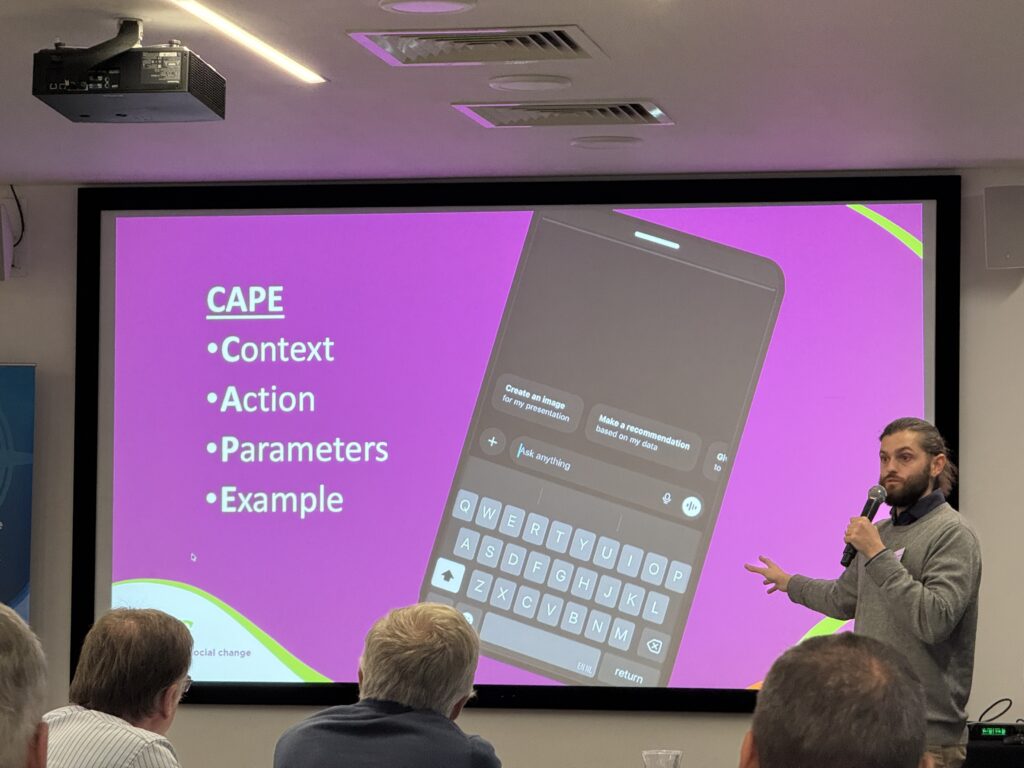
To help users write better prompts, George introduced a simple method called the CAPE method, an acronym for Context, Action, Parameters, and Example. This structure gives the AI more of what it needs to produce strong, predictable results. If a welfare worker wants AI to rewrite a fundraising line, the context explains the mission’s goals, the action states the task clearly, the parameters define tone and length, and the example demonstrates the desired style. This method also reduces the editing burden that frustrates new users.
Practical demonstrations made the possibilities concrete. George showed how a list of dates could instantly become an .ics calendar file, how an untidy list of names and targets could become a clean spreadsheet for mail-merge, and how numerous pages of training feedback could be distilled into clear patterns and recommendations. For seafarers’ centres managing volunteers, donors, reports, or Port Welfare Committee documents, these abilities promise to save substantial time.
As the workshop came to a close, attention turned to organizational readiness. George encouraged participants to form internal AI working groups and policy documents. The goal is not expertise but intentionality: a place to share ideas, test low-risk experiments, and reflect on what works. Some organizations also involve trustees, since governance bodies increasingly ask how digital tools are used.
George’s closing reflection was memorable. People will not be replaced by AI, he said, but they may be replaced by someone who learns to use AI well. The workshop ended with the shared recognition that AI is no longer a distant topic for future conferences. It is a tool that can serve welfare organizations today when embraced with humility, curiosity, and care, becoming a partner in the long tradition of supporting the people of the sea.
George Knight can be contacted here and is available to lead training groups.