
by Jason Zuidema (ICMA)
On a quiet street just off Eccleston Square in London, inside the head office of Stella Maris UK, the global scale of maritime life feels unexpectedly close. Ships move unseen across oceans, carrying most of the world’s goods, yet here the conversation is about something far more human: prayer, presence, and the quiet power of a Sunday in July.
Sea Sunday, held each year on the second Sunday of July, is one of those rare moments when the largely hidden world of seafarers comes into view. While many churches and denominations have long marked maritime life in different ways, remembering seafarers, fishers, and the wider maritime community in prayer and thanksgiving, leading maritime missions in the United Kingdom made a distinctive ecumenical choice that has global influence: to unite around a single Sunday, amplifying a shared message of recognition and care. Established in 1975 through the cooperation of organizations such as Sailors’ Society, Mission to Seafarers, and Stella Maris, Sea Sunday remains a remarkable legacy of ecumenical partnership, offering a model that could be fruitfully adapted in many other contexts.

Within this shared tradition, Stella Maris UK has developed one of the most intentional and far-reaching Sea Sunday programs. Sitting in conversation at Stella Maris UK’s headquarters, Tim Hill reflects on what makes Sea Sunday work. “Sea Sunday is the second Sunday in July,” he says. “It’s a Catholic worldwide opportunity to celebrate the lives and the work and the sacrifice made by seafarers and fishers in moving vital world trade and for putting food on our plates.”
The simplicity of the idea belies its reach. In England and Wales, Sea Sunday is woven into the life of the Church as a mandatory second collection. “We are very fortunate,” Hill explains, “that in England and Wales it is a mandatory second collection… one of twelve throughout the year.” That structure gives Sea Sunday a firm institutional footing. But the deeper impact, he insists, lies in the order of what is communicated.
“First and foremost, celebrate the lives and the work and the sacrifice made by seafarers and fishers,” he says. “Secondly, explain the work that the Church’s maritime charity does… and then, if they so wish, would they please make a donation.”
This sequence is more than practical; it is theological. It places recognition before request, gratitude before giving. In parish after parish, the day unfolds through prayer, preaching, and presence. Sometimes a visiting chaplain or volunteer speaks. Sometimes the parish priest adapts prepared materials. Hill recalls a Sunday in central London where he spoke at three consecutive services. “It’s about thanking and praying for the lives of seafarers and fishers,” he says. “Then educating people about Stella Maris… and finally, if you can make a contribution, then that’s much appreciated.”
If the public face of Sea Sunday is liturgical, its hidden strength is relational. “The secret behind Sea Sunday,” Hill says without hesitation, “is getting a parish contact.” These local champions—sometimes volunteers, sometimes ship visitors—form the connective tissue between the maritime world and the parish. They ensure that Sea Sunday is not an isolated event but part of an ongoing relationship.
A parish contact, Hill explains, is someone who “maintains that link between the church, the parishioners and Stella Maris.” They distribute materials, place notices in bulletins, organize small events, and, crucially, tell the story in a way that resonates locally. Where such a person is present, participation grows. The message becomes tangible.
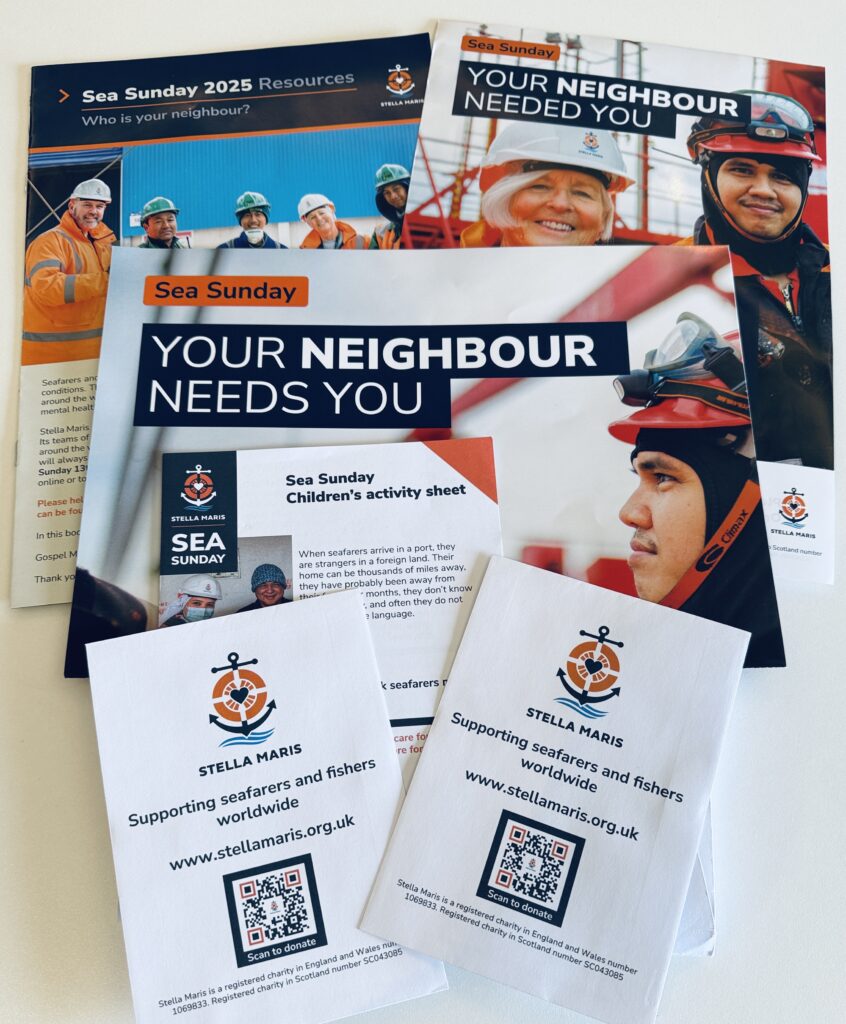
This local dimension is reinforced by careful preparation. Stella Maris UK invests heavily in what Hill calls the “Sea Sunday pack,” a comprehensive set of materials designed to make participation as easy as possible for busy clergy and volunteers. It includes bulletin texts, posters, children’s resources, and a prepared address that can be read or adapted. “You’re reducing the burden on the parish priest,” Hill notes, while ensuring that the message is communicated clearly and consistently.
And yet, even as the day itself is carefully orchestrated, Hill is quick to point out that its significance extends far beyond a single Sunday. “Sea Sunday is the start of the donor journey,” he says. A contribution made in July can lead to a deeper connection over time: newsletters, updates, and eventually sustained support. Some donors give modestly; others give more substantially. But all of them begin with that initial moment of awareness.
The financial impact is significant. Sea Sunday represents a substantial portion of Stella Maris UK’s annual income, approximately 20%. But its true value lies in its capacity to build relationships. It opens a door into the life of maritime ministry for individuals who may never have considered it before. It connects the pew to the port.
Even in the UK, however, the model is not fully realized. Of approximately 2,000 churches, Stella Maris has active parish contacts in only a fraction. “We’re only in about 10 percent,” Hill observes. The implication is clear: the potential for growth remains considerable.
For those in other countries looking to strengthen or establish a Sea Sunday observance, Hill’s advice is both straightforward and strategic. It begins with leadership. “You’ve got to get buy-in from the bishops and the diocese,” he says. Without that endorsement, the message struggles to gain traction.
From there, the focus shifts to the local level. Build relationships with parish priests. Prioritize engagement where it can be sustained. And invest in people who can carry the message forward. “If you’re able to form a parish contact,” Hill explains, “you need to support them… keeping them regularly informed… offering advice and opportunities.”
Preparation, too, is essential. A well-crafted set of materials can make the difference between a message that is heard and one that is overlooked. And finally, the message itself must be compelling. Not every speaker will have firsthand experience of ship visiting, but the story must still be told in a way that is vivid and real.
What emerges from this conversation is a vision of Sea Sunday as more than a date in the calendar. It is a bridge between worlds: between ship and shore, between global trade and local faith, between the unseen and the remembered. It is, at its best, an expression of the Church’s capacity to notice those who are often overlooked.
Sea Sunday stands as a quiet but powerful reminder that behind every ship is a human story—and that, for one Sunday at least, those stories are brought into the light.
For more Stella Maris UK Sea Sunday materials.
For Sea Sunday materials from various partners see this page at NAMMA.